Best Animation Couse in Hyderabad:complete career guide pillar
What is 3D Animation and Why is it the Best Career Choice for Students in Hyderabad in 2026? Home Blog Contact us Explore the best
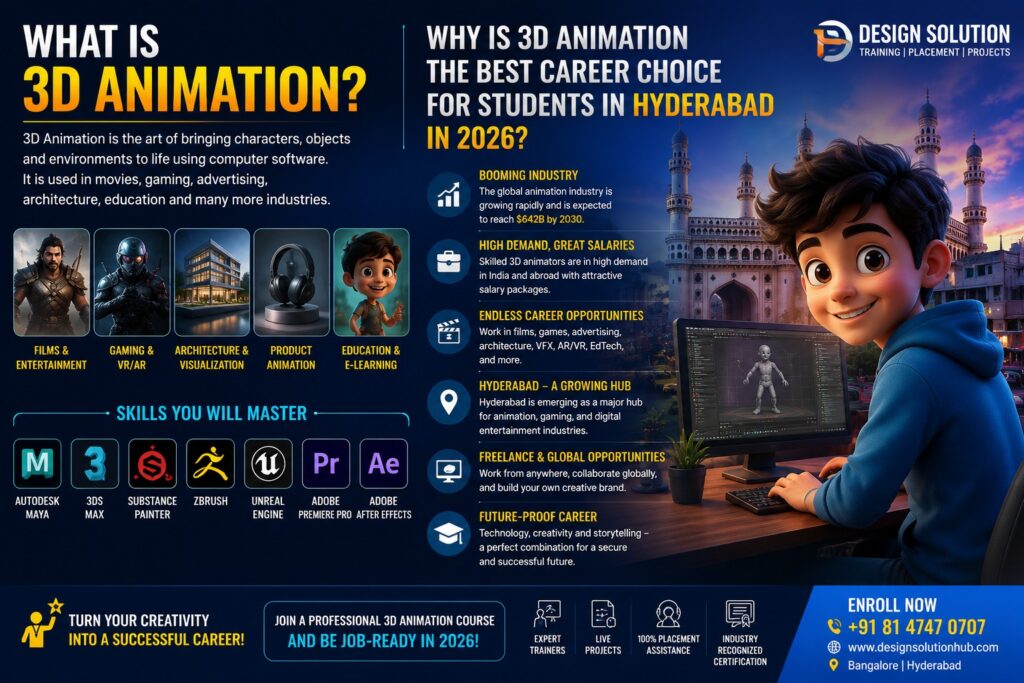
Hyderabad has quietly become one of the most exciting cities in India for creative professionals. From the studios behind international VFX blockbusters to the gaming companies building the next generation of mobile titles, the demand for skilled 3D animation professionals in this city has never been higher. For students standing at the crossroads of choosing a career path in 2026, 3D animation represents something rare: a field where artistic passion and technology converge into a stable, growing, and globally relevant profession.
But before diving into why Hyderabad students are increasingly gravitating toward this field, it is worth understanding what 3D animation actually is — how it works, what it produces, and why it powers so much of the visual world around us today.
3D animation is the process of creating moving images in a three-dimensional digital environment. Unlike traditional 2D animation, where characters and objects exist on a flat plane, 3D animation gives subjects volume, depth, and the illusion of physical reality. Every object in a 3D scene exists as a mathematical model a mesh of points, edges, and polygons — that can be viewed, lit, and moved from any angle.
The process begins with modeling, where an artist sculpts a character or object in digital space using software. This is followed by rigging, which involves building a virtual skeleton inside the model so it can move realistically. Then comes animation itself, where the artist defines how those joints and muscles move over time. After animation comes texturing — adding surface details like skin, fabric, or metal followed by lighting, which creates shadows, highlights, and atmosphere, and finally rendering: the computationally intensive process of converting the 3D scene into a sequence of final 2D images.
What you see in a Bollywood visual effects sequence, a PlayStation game cutscene, an architectural walkthrough video, or a product advertisement on Instagram most of it passes through some version of this pipeline.
Students often wonder whether to pursue 2D or 3D animation as a career direction. The distinction is more than visual style.
2D animation works with flat images on an X and Y axis. It is rooted in traditional hand-drawn techniques, now executed digitally through software like Toon Boom Harmony or Adobe Animate. It remains the dominant form for many children’s television shows, explainer videos, and motion graphics.
3D animation adds a Z axis depth which creates a sense of volume and spatial realism. It is the dominant form in feature films, AAA video games, VFX for live-action cinema, architectural visualization, medical animation, and product visualization for industries like automotive and manufacturing.
In terms of industry demand in 2026, both have value. However, the scope of 3D animation is significantly broader because its applications extend far beyond entertainment into engineering, healthcare, education, and advertising.
3D animation is not a single skill it is an umbrella that covers a family of interconnected disciplines. Understanding these helps students choose a specialization that matches their strengths.
Choosing a VFX course at MAAC Kukatpally allows aspiring artists to enhance their technical and creative abilities, build a strong portfolio, and access exciting career opportunities in film, television, gaming, advertising, and digital media. The institute ensures students are fully prepared to meet the global demand for skilled VFX professionals.
Character animation involves bringing digital characters to life through movement. A character animator studies human and animal motion and translates it into believable digital performance. Studios like Prana Studios and DQ Entertainment in Hyderabad specifically hire professionals with strong character animation skills.
VFX (Visual Effects) and compositing is the art of blending 3D-rendered elements with live-action footage. Think of the fire in a Tollywood action sequence or the destruction of a city in a science fiction film. VFX compositors use tools like Nuke, After Effects, and Fusion to seamlessly integrate these elements.
VFX (Visual Effects) and compositing is the art of blending 3D-rendered elements with live-action footage. Think of the fire in a Tollywood action sequence or the destruction of a city in a science fiction film. VFX compositors use tools like Nuke, After Effects, and Fusion to seamlessly integrate these elements.
Lighting and rendering is a technically demanding specialization that focuses on creating photorealistic or stylized light behavior in 3D environments. Lighting TDs (Technical Directors) are crucial to the final visual quality of any 3D film or game.
Rigging involves building the digital skeletons and control systems inside 3D characters. It sits at the intersection of art and programming, making it a particularly valued and well-paid specialization in every studio pipeline.
Motion graphics blends 3D animation with graphic design to create animated visual communication — from broadcast channel idents to social media content. This specialization has exploded in demand with the rise of digital marketing and branded content production.
The tools of 3D animation have become an industry in themselves. Understanding which software to learn is one of the first practical questions every student asks.
India’s animation, VFX, and gaming industry has been on an accelerating growth curve. The Indian Media and Entertainment sector continues to grow at double-digit rates, with animation and VFX being among the fastest-growing segments. International studios outsource significant portions of their production work to Indian studios, attracted by the combination of technical skill, English proficiency, and cost efficiency.
The rise of OTT platforms Netflix, Amazon Prime Video, Disney+ Hotstar, Apple TV+, and regional streaming services — has fundamentally changed the demand landscape for animation professionals. These platforms are green-lighting more original animated content than at any point in history. Each production requires a full pipeline of modelers, animators, riggers, lighters, and compositors.
India’s gaming industry is undergoing its own transformation. Mobile gaming has made India one of the world’s largest gaming markets by user count. Game studios both homegrown Indian developers and international publishers establishing India operations — are creating sustained demand for 3D artists skilled in game engine workflows.
Hyderabad occupies a unique position in India’s creative media landscape. The city is home to major production studios, a thriving film industry in Tollywood, and an established technology ecosystem that has naturally expanded into gaming, virtual reality, and digital content creation.
Several globally recognized studios and post-production facilities are based in or near Hyderabad. The Tollywood film industry, centered in Film Nagar and Ramoji Film City, is one of the most prolific regional film industries in India and one of the most technically ambitious consistently pushing the boundaries of VFX work. This creates a steady, local pipeline of employment for animation and VFX professionals.
Hyderabad’s position as a major IT and technology hub means it has attracted international companies, several of which have digital content and gaming divisions. The city’s infrastructure connectivity, relative cost of living compared to Mumbai, and the presence of a large student population makes it both an attractive place for studios to operate and for students to study and build careers.
The presence of animation students and professionals also creates a creative community: networking events, portfolio workshops, independent studios started by young graduates, and mentorship networks. That ecosystem feeds on itself more skilled graduates attract more studios, which creates more opportunities, which attracts more students.
Students who develop strong 3D animation skills can pursue a wide variety of career directions. The field is far broader than most people initially imagine.
Works in film, television, gaming, or advertising to create believable character performances. Starting salaries in Hyderabad for junior animators are typically in the range of INR 2 to 3.5 LPA, growing significantly with experience and specialization.
Works on live-action film and video productions to integrate computer-generated imagery with real footage. The Tollywood industry maintains consistent demand for VFX compositors with strong software skills in Nuke, After Effects, and Fusion.
Creates the visual assets that populate video games — characters, environments, vehicles, and props. As Hyderabad’s gaming industry grows, this role has become one of the more plentiful entry-level positions available to fresh graduates with strong portfolios.
Creates animated content for digital advertising, broadcast media, social media, and corporate communication. This career path has one of the fastest entry timelines into the industry, with strong freelance potential from early in a career.
Works with real estate developers, architects, and interior designers to create photorealistic 3D renders and walkthrough animations of buildings and spaces. Hyderabad’s expanding real estate sector creates ongoing, consistent demand for this specialization.
A higher-specialization role combining technical and artistic skills. Riggers and lighting TDs are consistently among the most in-demand and highest-paid professionals in studio production pipelines globally and in India.
3D animation suits a particular type of student though perhaps a broader range than is commonly assumed. The persistent misconception is that only those who can draw should pursue animation. In reality, 3D animation is a technical-artistic discipline where spatial reasoning, observational skill, and attention to motion are more fundamental than traditional drawing ability.
Students who have an interest in films and visual storytelling, enjoy working with technology and software, are patient and detail oriented, and find satisfaction in iterative creative work tend to thrive in this field. The pipeline is long and requires sustained focus but it rewards that patience with results that can be extraordinary.
Students with a background in science or engineering often find 3D animation surprisingly accessible, particularly in specializations like rigging, simulation, and lighting that rely heavily on mathematical and computational thinking. After completing 10th or 12th grade, students can begin structured 3D animation training without needing any prior technical background.
Students apply these tools through guided assignments, live projects, and practical exercises, ensuring hands-on experience with industry-standard software. This training equips learners of the VFX course at MAAC Kukatpally to confidently handle real-world projects and meet the requirements of film studios, animation companies, advertising agencies, and gaming studios. By mastering these software programs, students develop the technical proficiency and creative skills needed to excel as professional VFX artists, compositors, motion graphics designers, and digital animators, preparing them for a successful career in the competitive world of visual effects and animation
Artificial intelligence is reshaping workflows across every creative field, and 3D animation is no exception. AI tools are accelerating tasks like facial animation, body motion capture cleanup, texture generation, and background rendering. Studios are using AI to reduce the time and cost of production particularly for labor-intensive tasks that previously required large teams.
However, this is not displacing human animators. Instead, it is changing the profile of what animators spend their time doing. The mechanical and repetitive parts of the pipeline are being assisted or automated, freeing animators to focus on the creative, directorial, and performance-driven aspects of their work. Animators who understand how to work with AI tools — and who bring strong artistic judgment to the process are becoming more valuable, not less.
For students entering the field in 2026, understanding AI-assisted workflows alongside traditional software skills is becoming part of what it means to be a well-rounded animation professional.
In 3D animation, no resume element carries more weight than a showreel. A showreel is a short compilation — typically 60 to 90 seconds — of an artist’s best work. It is the primary instrument through which studios evaluate candidates, and it matters far more than academic credentials.
This means that from the very beginning of their learning journey, animation students should be thinking about what work they are creating, how it demonstrates their skills, and how it is presented online. Strong portfolio work from personal projects, student productions, and internship assignments consistently results in employment for skilled graduates, regardless of which city they are based in.
Enrolling in a VFX course at MAAC Kukatpally allows aspiring artists to develop both creative and technical expertise, giving them a competitive edge in the international VFX and animation industry. This global exposure enables students to explore diverse career paths, participate in international projects, and achieve professional growth in visual effects, animation, gaming, and digital media, making them ready for success anywhere in the world.
Yes. Hyderabad’s established film, gaming, and digital media industry creates consistent local demand for skilled 3D animation professionals. The city is home to studios, post-production houses, and gaming companies that regularly hire talented graduates from structured animation training programs.
The scope is broad and expanding. Film VFX, gaming, OTT content, advertising, architectural visualization, e-learning content, and virtual production are all active and growing markets for 3D animation talent in India. International studios also outsource heavily to Indian talent pools.
An interest in visual arts, physics (for simulation and movement), and computer science (for technical tools and game engines) gives students a strong foundation. However, most structured animation programs are designed to teach all required technical skills from the ground up — no prior background is needed.
Foundation skills in 3D modeling, rigging, and animation can be developed over 12 to 18 months of structured training. Specialization and professional-level proficiency typically develop over 2 to 3 years, including practical project work and portfolio building.
3D animation refers broadly to the creation of animated content in a three-dimensional digital environment. VFX (Visual Effects) specifically refers to the integration of digitally created imagery with live-action footage. VFX relies heavily on 3D animation skills, but also incorporates compositing, color science, and film production knowledge.
What is 3D Animation and Why is it the Best Career Choice for Students in Hyderabad in 2026? Home Blog Contact us Explore the best
Maya vs Blender for Beginners: What Animation Students Should Know Home Blog Contact us Hyderabad has quietly become one of the most exciting cities in
What is 3D Animation and Why is it the Best Career Choice for Students in Hyderabad in 2026? Home Blog Contact us The creative industry
Camera Tracking Course in Hyderabad: Learn Mocha, PFTrack and Matchmove Basics for a Successful VFX Career Home Blog Contact us Visual effects have transformed modern
What is 3D Animation and Why is it the Best Career Choice for Students in Hyderabad in 2026? Home Blog Contact us The demand for
YouTube Video Editing Course in Hyderabad: Editing, Thumbnails and Channel Growth Home Blog Contact us Hyderabad has quietly become one of the most exciting cities
UI UX Course in Hyderabad: Skills, Tools, Portfolio and Career Scope Home Blog Contact us Today in digital world, every successful website, mobile app, and