Best Animation Couse in Hyderabad:complete career guide pillar
What is 3D Animation and Why is it the Best Career Choice for Students in Hyderabad in 2026? Home Blog Contact us Explore the best
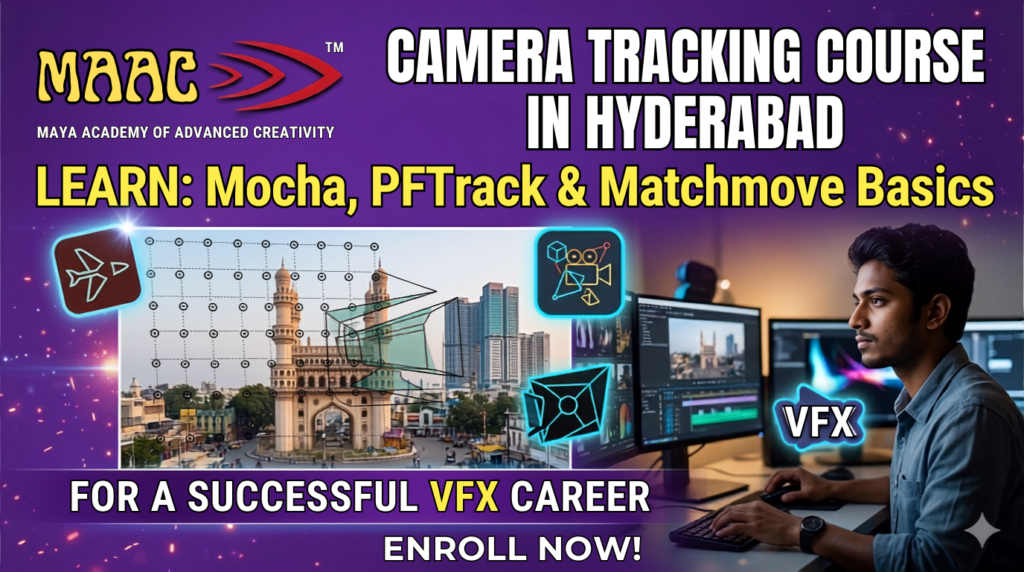
Visual effects have transformed modern filmmaking. Whether it is a Hollywood blockbuster, a Bollywood action sequence, a Netflix web series, or a television commercial, realistic visual effects rely on accurate camera tracking. Behind every breathtaking CGI scene is a skilled artist who understands how to combine live-action footage with computer-generated elements seamlessly.
If you dream of working in the VFX industry, enrolling in a camera tracking course in Hyderabad is one of the smartest career decisions you can make. Camera tracking is among the most in-demand technical skills in VFX production because every complex visual effects shot starts with accurate matchmoving.
Today’s studios use professional software such as Mocha, PFTrack, and various matchmove techniques to recreate real-world camera movement inside a 3D environment. These tools help
VFX artists integrate CGI into live-action footage naturally, making impossible scenes appear realistic.
In this comprehensive guide, you’ll learn what camera tracking is, why it matters in filmmaking, how Mocha and PFTrack are used professionally, career opportunities after learning these tools, and why MAAC Kukatpally is an excellent place to begin your journey.
Camera tracking, also known as match moving, is the process of analyzing live action footage and recreating the exact movement of the camera inside a 3D software environment.This process allows VFX artists to insert CGI objects, characters, explosions, buildings, or environments into a real video while maintaining perfect perspective and movement.Without proper tracking, CGI objects appear to float unnaturally or fail to align with the scene.For example, imagine adding Iron Man flying through Hyderabad’s skyline. Before creating the animation, artists must first recreate the camera movement accurately. This is where camera tracking becomes essential.Professional VFX studios use software like Mocha,PFTrack,3DEqualizer,Blender Tracking,Nuke Camera TrackerAmong these, Mocha and PFTrack are industry favorites because they provide accurate and efficient tracking solutions.
The demand for realistic visual effects continues to grow across films, OTT platforms, advertising, gaming, and virtual production. Every VFX-heavy production requires tracking artists before compositing begins .Camera tracking is used in Hollywood Movies Super hero films, science fiction movies, fantasy worlds, and creature animations all rely on accurate tracking .Bollywood Films Historical dramas, action sequences, fantasy scenes, and large scale CGI environments depend heavily on match moving. Advertisements brands frequently combine live-action footage with animated products or visual effects. OTT Series Streaming platforms produce VFX rich content that requires skilled tracking artists. Gaming Cinematics game trailers often combine real footage with computer-generated characters. Because of this growing demand, professionals trained in camera tracking enjoy excellent career opportunities.
Tracks moving objects instead of cameras.Match moving is the foundation of camera tracking.The objective is simple Recreate the exact movement of the physical camera inside a digital 3D environment.A tracking artist analyzes Camera motion ,Lens information, Scene perspective, Tracking markers, Object movement Once this data is solved, 3D artists can confidently place digital assets into the scene
2D tracking is the process of tracking the movement of an object or surface in a video on a flat plane using the X and Y axes. It does not calculate depth (Z-axis), making it ideal for tasks where only the position, scale, and rotation of a flat surface need to be tracked. This technique is widely used in visual effects and motion graphics to ensure that digital elements remain accurately attached to moving objects throughout a shot. Common applications of 2D tracking include screen replacements on mobile phones, televisions, or laptops, adding motion graphics, placing company logos on moving objects, and attaching text or labels to scenes.
3D camera tracking, also known as camera matchmoving, is a technique used to recreate the movement of a real camera within three dimensional space. Unlike 2D tracking, it calculates movement along the X, Y, and Z axes, allowing 3D objects to be seamlessly integrated into live action footage. This method enables visual effects artists to place computer generated elements into a scene so they move naturally with the camera. It is commonly used for adding CGI buildings, animated creatures, digital environments, virtual production sets, and other complex visual effects that require realistic interaction with the filmed environment.
Object tracking focuses on following the movement, rotation, and sometimes the scale of a specific object within a video rather than tracking the camera itself. This technique is essential when a moving object needs to be replaced, enhanced, or augmented with computer-generated elements. Object tracking is frequently used for replacing props, attaching digital accessories such as helmets, watches, or glasses to actors, tracking vehicles, and integrating visual effects that must stay perfectly aligned with a moving object throughout a scene. It plays a crucial role in ensuring realistic and believable VFX integration.
Mocha is one of the most trusted and widely used planar tracking software applications in the visual effects industry. It is widely used in films, television, commercials, and digital content creation for its accurate and reliable tracking capabilities. A Mocha course teaches students professional planar tracking techniques used for screen replacements, object removal, and advanced compositing. The most important feature of Mocha is planar tracking. Unlike traditional point tracking, which follows individual tracking points, planar tracking follows an entire flat surface. This provides more stable and accurate results, even when objects move quickly or become partially hidden, making it ideal for complex visual effects shots.
Mocha is commonly used for replacing mobile, laptop, and television screens, editing billboards and signboards, inserting logos onto moving objects, removing unwanted objects, and cleaning up reflections. These tasks are frequently performed in films, advertisements, television shows, and corporate videos. Professionals prefer Mocha because it delivers reliable tracking even in challenging conditions such as motion blur, low contrast footage, partial occlusion, and fast camera movement. These advanced capabilities make it one of the industry’s most dependable tracking tools. Mocha also integrates seamlessly with industry standard software such as Adobe After Effects, Adobe Premiere Pro, and Nuke, allowing artists to transfer tracking data directly into their post production workflow.
By mastering Mocha, students gain a valuable production skill used daily in professional VFX studios. This expertise prepares them for careers in animation and visual effects, enabling them to work confidently on screen replacement, object removal, motion graphics, and advanced compositing projects.
PF Track is one of the most powerful and widely used match moving software applications in the visual effects industry. It is designed for advanced 3D camera tracking and is trusted by professional VFX studios for feature films, television series, commercials, and virtual production projects. A PF Track course provides students with practical knowledge of professional tracking workflows, enabling them to accurately recreate real world camera movements and seamlessly integrate computer generated (CGI) elements into live action footage.
One of PF Track’s most valuable features is Automatic Camera Solving. The software analyzes multiple tracking points within a video and automatically calculates the camera’s movement in three dimensional space. This significantly reduces manual effort while producing highly accurate camera data for visual effects and animation projects.
Another important capability of PF Track is Lens Distortion Correction. Different camera lenses introduce distortion that can affect tracking accuracy. PF Track identifies and corrects these distortions before the tracking process begins, ensuring that CGI objects align naturally with the original footage and creating more realistic visual effects.
PF Track also excels in Scene Reconstruction, allowing artists to generate an accurate three dimensional representation of the filmed environment. By rebuilding the scene’s geometry, VFX artists can position digital objects, environments, and characters with realistic scale, perspective, and depth, making CGI elements blend seamlessly into live action scenes.
A key feature of PF Track is Point Cloud Generation, which creates a collection of three dimensional reference points from the tracked footage. These point clouds provide precise spatial information that helps artists accurately place CGI assets, digital environments, and visual effects within the scene while maintaining proper alignment with the original camera movement. In addition to camera tracking, PF Track offers powerful Object Tracking tools. These tools enable artists to track moving objects such as vehicles, props, characters, and other dynamic elements independently of the camera. Object tracking is widely used for replacing props, adding digital effects, integrating animated characters, and enhancing live action footage with realistic CGI. PF Track is also known for its excellent compatibility with industry standard 3D and compositing software. It integrates seamlessly with applications such as Autodesk Maya, Blender, Houdini, Unreal Engine, and Nuke, allowing artists to transfer camera data and tracking information efficiently throughout the production pipeline. This smooth integration makes PF Track one of the most preferred camera tracking solutions used by leading VFX studios around the world.
A professional camera tracking course in Hyderabad goes far beyond software training.
Students learn complete production workflows.
Understanding Camera Motion Learn how different camera movements affect tracking quality.
Tracking Shot AnalysisIdentify difficult shots before solving.
Marker PlacementUnderstand how tracking markers improve accuracy.
Solving Camera MovementGenerate accurate camera data for CGI integration.
Scene CleanupRemove unwanted tracking points and optimize solves.
Exporting to 3D Software Transfer solved cameras into Maya or Blender.
Pipeline IntegrationWork with compositors and 3D artists using professional workflows.
Live ProjectsPractice using production-quality footage similar to real studio wo
The VFX industry has experienced tremendous growth over the past decade.The expansion of OTT platforms, gaming, animation, advertising, virtual production, and immersive media has significantly increased the demand for skilled tracking artists.Companies now look for professionals who understand: Camera tracking,Matchmoving,Compositing,Rotoscoping,Green screen workflows,CGI integration
After completing a VFX tracking course, students can work as:Camera Tracking Artist, Match move Artist, Junior VFX Artist, Compositor, Layout Artist, Roto Artist, Tracking Supervisor (with experience)
Film Production ,Television, OTT Platforms, Advertising Agencies, Gaming Studios, Animation Studios, Virtual Production Companies Professionals with multiple VFX skills often enjoy faster career growth and better salary opportunities.
Imagine filming a commercial where a giant animated robot walks through Hyderabad’s streets. Without camera tracking :The robot would slide unnaturally .Shadows would not align .Perspective would look incorrect. With Mocha and PF Track: The camera movement is recreated perfectly .The robot matches the scene naturally. Lighting and perspective remain realistic .This is exactly how major studios create believable visual effects.
Choosing the right training institute is just as important as choosing the right software.MAAC Kukatpally offers industry-oriented VFX education designed to prepare students for real production environments.Students benefit from:
Experienced Faculty Learn from trainers with practical VFX production knowledge.
Industry Oriented Curriculum The course covers camera tracking, compositing, animation, and visual effects workflows.
Practical Learning Students work on projects inspired by real production pipelines.
Modern Labs Practice on high-performance systems with industry-standard software.
Portfolio Development Build a professional demo reel that showcases your camera tracking skills.
Placement Assistance Receive career guidance, interview preparation, and placement support to help you begin your professional journey.Its convenient location also makes it accessible for students from Kukatpally, Ameerpet, Dilsukhnagar, and other parts of Hyderabad.
Not at all. With proper guidance and regular practice, beginners can master the fundamentals of camera tracking and match moving.
Mocha is an excellent starting point for planar tracking, while PFTrack is ideal for advanced 3D camera tracking workflows.
No. Most beginner-level courses start with the fundamentals before progressing to advanced techniques.
Yes. Skilled camera tracking artists are in demand across films, OTT platforms, advertising agencies, gaming companies, and animation studios.
Basic concepts can be learned in a few weeks, while mastering production-level workflows typically requires several months of structured training and practice.
What is 3D Animation and Why is it the Best Career Choice for Students in Hyderabad in 2026? Home Blog Contact us Explore the best
Maya vs Blender for Beginners: What Animation Students Should Know Home Blog Contact us Hyderabad has quietly become one of the most exciting cities in
What is 3D Animation and Why is it the Best Career Choice for Students in Hyderabad in 2026? Home Blog Contact us The creative industry
Camera Tracking Course in Hyderabad: Learn Mocha, PFTrack and Matchmove Basics for a Successful VFX Career Home Blog Contact us Visual effects have transformed modern
What is 3D Animation and Why is it the Best Career Choice for Students in Hyderabad in 2026? Home Blog Contact us The demand for
YouTube Video Editing Course in Hyderabad: Editing, Thumbnails and Channel Growth Home Blog Contact us Hyderabad has quietly become one of the most exciting cities
UI UX Course in Hyderabad: Skills, Tools, Portfolio and Career Scope Home Blog Contact us Today in digital world, every successful website, mobile app, and